
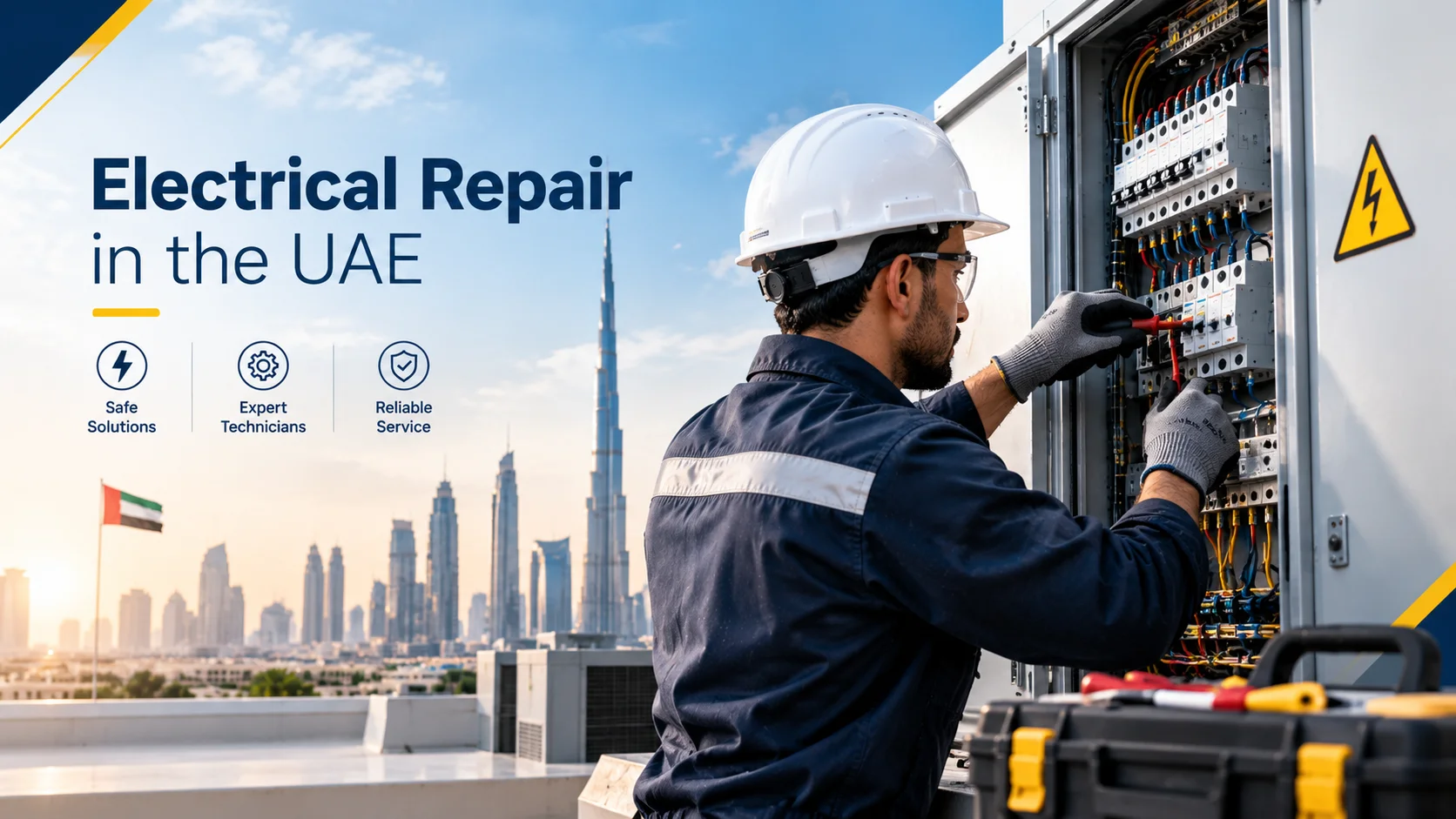
Electrical Repair in the UAE: What Homeowners and Tenants Should Know
Table of Contents
It usually starts small. One socket in the bedroom stops charging your phone. The living room lights flicker when the AC kicks in. A breaker trips on a Friday evening, you flip it back, and it trips again ten minutes later.
Most people shrug these off for a week or two. That’s understandable, but electrical faults rarely fix themselves. They tend to get worse, and sometimes they get worse quickly.
This guide walks through what electrical repair actually involves, the problems we see most in UAE apartments and villas, what you can check on your own, and when it’s time to stop and call a home electrician.
So, what does electrical repair actually mean?
In plain terms, it’s finding out why something electrical in your home isn’t working properly and fixing it so it’s safe again. That could be a dead socket, a damaged cable inside a wall, a worn-out switch, or a distribution board (DB) that’s struggling to cope.
The important word is finding. A good electrician doesn’t just swap parts and hope. They trace the problem to its source, fix that, and test the circuit before they leave. If they only reset the breaker and walk away, you’ll probably be calling again next month.
Our main electrical repair service page covers the full range if you’d like the overview.
The problems we see most in UAE homes
Air conditioning runs for months on end here, water heaters, ovens and washing machines all pull serious power, and plenty of homes have been renovated or rented out several times. Put that together and a few faults come up again and again.
The breaker that keeps tripping
A breaker trips to protect your wiring. Once is often just an overloaded circuit, say a kettle, a microwave and an iron all running together. If it keeps happening, something else is going on: a faulty appliance, a damaged cable, moisture, or a breaker that’s simply worn out. We’ve written a separate piece on why your circuit breaker keeps tripping, and if you need hands-on help, see our circuit breaker repair page.
Sockets that don’t work, or feel warm
A dead socket is annoying. A warm, discoloured or crackling socket is a different matter, and you should stop using it straight away. The cause is often a loose connection or worn contacts, and sometimes a cable problem further back in the wall. Fixing or replacing it is a short job for a pro. Details are on our power socket repair page.
Flickering or dimming lights
If one bulb flickers, try replacing it. If the lights dim every time the AC or a heavy appliance starts, or flicker across several rooms, the problem is probably in the wiring or a connection rather than the lamp. Our guide on why lights flicker and when to worry goes deeper, and the lighting repair page covers LED drivers, downlights and ceiling fixtures.
Faulty or ageing wiring
This is the one people tend to find out about late. Warning signs include a burning smell, buzzing from the wall, sockets that look scorched, and frequent bulb failures. Older villas and heavily modified rental units are the usual suspects. Read warning signs of faulty wiring or see our electrical wiring repair service.
Short circuits
A short circuit is usually loud and obvious: a pop, a tripped breaker, sometimes a smell or a black mark. It means current has taken a path it shouldn’t. Don’t keep resetting the breaker. Switch the circuit off and get it traced properly.
Switches, ceiling fans and the odd ones out
A cracked switch, a fan that hums or crawls, a ceiling light that won’t come on. These are often simple parts failing, but they can also point to a loose connection, so it’s worth having them looked at properly.
Power gone in just your flat
If your neighbours still have power and you don’t, check your DB first. If the whole building is dark, call building management or your utility provider. Our short guide on what to do during a sudden power failure has a quick checklist.
When to stop and call someone right now
Some things shouldn’t wait for the weekend:
- A burning smell near a socket, switch or the DB
- Scorch marks, melted plastic or sparks
- A breaker that won’t reset, or trips straight away
- A tingle or shock when you touch an appliance or switch
- Crackling or buzzing from a wall or panel
- Bare or damaged wires
If any of those apply, switch off the circuit if you can do it safely, keep kids and pets away, and book an emergency electrician.
What you can safely check yourself
Nothing involving opening a socket, a switch or the DB. But there are a few sensible things to do while you wait:
- Look at your DB and see if a breaker has dropped. Reset it once. If it trips again, leave it off.
- Unplug everything on that circuit. Sometimes it’s an appliance, not the wiring.
- Keep away from wet electrical items and exposed wires.
- Jot down what was running when it happened and anything you heard or smelled. It really does help the electrician.
- Clear the area around the DB so they can get to it quickly.
What happens during a proper repair
It shouldn’t be a mystery. A decent visit goes roughly like this:
- You describe the problem and agree a time.
- The electrician inspects the circuit and tests it to find the cause.
- You’re told what’s wrong and what it will cost before any work starts.
- The fault is repaired with parts that suit the circuit.
- The circuit is tested again to confirm it’s safe.
- You get a plain explanation of what was done and how to avoid a repeat.
If an electrician can’t explain what they found, or won’t quote before starting, that’s worth noticing.
Jobs a home electrician typically handles
- Wiring repair and partial rewiring
- Socket, switch and outlet replacement
- Lighting repair, including LED fixtures and drivers
- Circuit breaker, MCB, RCCB and DB board repair or replacement
- Short circuit and earth fault tracing
- Ceiling fan electrical repair
- Electrical safety inspections
- Preventive maintenance
Renting or buying? Get the wiring checked first
Tenants and new owners often find out about electrical problems the hard way, a month after moving in. An electrical safety inspection before you settle in can show up loose connections, overloaded circuits and worn sockets while they’re still cheap to deal with. Landlords benefit too: it’s far easier to fix things between tenants than during one. Our electrical safety checklist for apartments and villas is a handy starting point.
How much does electrical repair cost in the UAE?
It depends. Replacing a socket or switch is a small job. Tracing a hidden wiring fault or replacing a DB board is not. The price moves with the type of fault, how long the diagnosis takes, the parts needed, the size of the property and whether you need someone urgently.
Be cautious if anyone quotes a firm price over the phone without seeing the problem. A fair quote separates the visit, labour and materials. For a rough idea of how pricing works, read our electrical repair cost guide, or send us a photo or short description of the fault and we’ll tell you what we’d look at first.
How to pick an electrician you can trust
- Do they look for the root cause, or just reset and replace?
- Will they give you a clear quote before starting?
- Can they explain the testing they do after a repair?
- Are their claims honest? Same-day and emergency service only mean something if they can really provide it.
- Do real customers say good things about them?
- Do they follow the safety requirements that apply in your emirate?
Frequently asked questions
What is the meaning of electrical repair?
It means finding and fixing faults in a property’s electrical system: wiring, sockets, switches, lights, breakers and the distribution board. A proper repair covers diagnosis, fixing or replacing the faulty part, and testing afterwards.
How to repair an electrical fault?
Start by switching off the affected circuit and unplugging whatever is connected to it. Check whether a breaker has tripped and reset it once. Past that point, leave it to a qualified electrician. They’ll find the fault with testing equipment, repair or replace the damaged part and test the circuit before handing it back. DIY work on wiring or a DB board risks shock and fire.
What are the 7 electrical tests?
There’s no single official list, but these seven come up most often in inspections and repairs: continuity, insulation resistance, polarity, earth fault loop impedance, RCD/RCCB operation, earth electrode resistance and prospective fault current. Which ones are needed depends on the job, and your electrician will choose accordingly.
What does an electrician repair?
Faulty wiring and cables, sockets and switches, light fixtures, ceiling fans, circuit breakers, distribution boards, short circuits and earthing problems. They also do inspections and routine maintenance.
How do I find electrical repair near me?
Look for a provider that actually covers your area, explains how it diagnoses faults, quotes before starting and has genuine reviews. For something urgent like a burning smell, pick one that offers emergency response.
Is there an emergency electrician in Dubai or Abu Dhabi?
Many providers offer emergency service. Always confirm availability, coverage and response time when you call, and switch off the affected circuit while you wait if it’s safe.
Why does my breaker keep tripping?
Common causes are an overloaded circuit, a short circuit, an earth fault, a faulty appliance or a tired breaker. If it trips again after one reset, leave it off and call an electrician.
Can I do electrical repairs myself?
Changing a bulb or resetting a breaker once is fine. Anything that involves wiring, sockets, switches or the DB belongs with a qualified electrician.
Need a hand?
Whether you’re in an apartment, a villa or a rented home, AdnanFixIt can help with wiring, sockets, switches, lighting and breaker problems. Tell us what’s happening and we’ll point you to the next safe step.